Sunday, June 06, 2010

St Peter's Square

  Still in Rome after all these posts...

We were lucky enough to get to St Peter's Square three times. 
First Rick and I ended there on our wandering tour. Next, our 
our guide surprised us with a visit on Palm Sunday to witness 
Pope Benedict XVI say Mass. And finally, in the early morning 
when we would do the postponed tour of the Vatican Museum 
and Sistine Chapel. These are some of my favorite photos from 
he visits...


Statues of 140 Christian martyrs flank the balustrade.


A fountain by Bernini (1675) 


Giant trinitrons just like at sporting events. 
What would these saints think?


But of course, all can see the Pope say Mass.
And this fountain is by Maderno (1613)


A bit farther away

The Sistine Chapel is amazing. no photos are allowed, 
which is OK because the room is dimly lit and  no photo 
that i take could do it justice. This is The Sistine Chapel 
from the square. It is where the Papal conclave occurs 
when the Cardinals are electing a new Pope. It is near 
where the white smoke is seen indicating that a new Pope 
has in fact been elected.
 

And finally my favorite of the day.
A member of the Swiss guard and a wannabe...

How cute is that.

If you are following my journey, thank you.
Feel free to leave a comment.
I would love to hear from you.

Thursday, June 03, 2010

St Peters Basilica

St Peter's Basilica is perhaps the most beautiful church I have ever been in. It's size is astounding. There are so many side altars and chapels. Numerous popes have been buried here. St Peter, the first Pope (upon this Rock, I will build my church) is buried beneath the main altar.

The entrance doors are large, as one might expect. There is a set of special doors, more ornate than any other, and these are called the Jubilee doors They are only opened during the Jubilee year celebration, which occurs every 25 years.


Looking down the center aisle to the main altar.


And a closer view


Don't you just love the ray of sun shining through the side window.

The most famous statue is Michelangelo Buonarroti's Pieta. In 1972, someone took a hammer to it and so it is now protected, placed behind plexiglass and roped off so that visitors can not get too close. My photo does not do justice to this work. To me one of the most amazing things is that Michelangelo was only 22 when he began this piece. It was completed within a year.


As with every church I saw in Rome, the beauty lies in all of the details.

Floors...


Columns...


Statuary...


There is so much to see.

Wednesday, June 02, 2010

The Vatican Museum

Journey on and we did. Having purchased tickets for the Vatican Museum online from the states, we gave ourselves away as the total tourists while standing at a map of the Vatican grounds trying to figure out just where we would go to pick them up. A young lady approached and asked if we wanted to participate in an English speaking tour beginning in 15 minutes. Rick and I quickly agreed. It was good money spent. Our tour guide was an American named Steve, from San Diego, living in Italy with a fine arts degree and of course, superb English. He knew just where to go to pick up our tickets and he did. YEAH!

What is not to like about the Vatican Museum except the sheer number of tourists. It was difficult to know whether to look up or down or just around, there is just so much to see. We were lucky because we actually went through the Museum twice. Our tour took us back in an early morning visit which was perfect for some of the photos I have captured here.(No tourist heads. LOL)

Upon entering, the first place you land is the Pigna Courtward, named for a colossal bronze pine cone, which is nearly 13 feet high.


Steps leading to the pine cone sculpture.


The detail of the pedestal supporting the pine cone.


Another spectacular sight is an enormous sphere in the center of the courtyard, sculpted by Arnoldo Pomodoro in 1990.  It rotates with just the slightest touch.


I love this peice, the detail in the hair is amazing. I don't really know how long ago it was done.


And then entering the Museum...
The statuary is exquisite, so rich in detail.


I learned that these statues had been painted way..... back in the day, but the paint had washed away. This is why the eyes do not have detail carved into them. It had been painted on.

The ceilings...
Much of this is fresco, which is a technique that paints directly on wet plaster. It is the reason this art has survived the years.


The ceiling in the Gallery of Maps which really does go on forever.


And finally, I share this really bad photo because the story that goes with is so funny.


This is supposedly Nero's bath tub. It really is huge and fills this large space.
The story goes that Nero had 6 wives. The first three were women, the next two were men and the last one was a horse. What... did he say?

Monday, May 10, 2010

Ponte Saint' Angelo

These photos give new meaning to the the words "light at the end of the tunnel". After wandering delightful alleyways and never really being sure we were on the right track, we could see light...at the end of the tunnel.
Blessings!


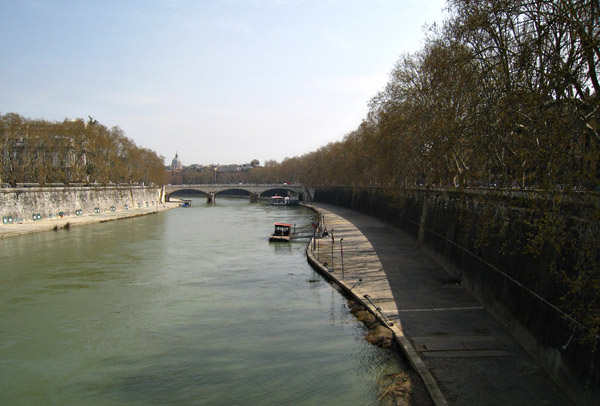
We spot our destination, the Ponte Sant' Angelo, the Bridge of Angels.


Image by Matthias with his permission.
http://en.wikipedia.org/wiki/File:StAngelo_Bridge_Rome.jpg

This Bridge spans the Tiber River, connecting the city center to the Castel Sant' Angelo.


The statuary on this bridge has been replaced several times in it's history. Bernini's program, one of his last large projects, called for ten angels holding instruments of the Passion.  He personally only finished the two originals of the Angels with the Superscription "I.N.R.I." and with the Crown of Thorns, but these were kept by Clement IX for his own pleasure. They are now in the church of Sant'Andrea delle Fratte, also in Rome.
The remaining angesl were sculpted by students of Bernini.


Angel with the Whips 


Angel with Cross
If you want to see an awesome artistic rendering of this photo, see Photoworks


Also on the bridge are sculptures of Sts Peter and  Paul. These remain from one of the earlier artistic renderings. Pigeons are the ruin of all photographers in Rome. I am pretty sure the locals don't care much for them either. And I am positive that St Peter doesn't.

If you look closely, you can just see the Sculpture of St Michael the Archangel on top of the Castel behind.

Tuesday, May 04, 2010

Piazza Navona

This piazza is large and open and has three delightful fountains.

In the center is Bernini's Fountain of the Four Rivers, representing the Nile, Ganges, Danube and della Plata. It was erected in 1651 in front of the church of Sant'Agnese in Agone, and yards from the Pamphili Palace belonging to this fountain's patron, Pope Innocent X  (1644-1655). This sculpture was being refurbished and was surrounded by plastic. Boo Hoo.
You can see the church with it's twin towers just behind the scuplture.


The Moor Fountain, located in the southern area of Piazza Navona, takes its name from the central figure, who is a Moor fighting with a dolphin. The work was sculpted based on a design of Bernini in 1654 by Giovanni Antonio Mari.


This fountain had all the water so the pigeons liked it as much as I did.
Gotta love those buns!


And then one who will sing?dance?sit? just whatever for his supper. This is not the third fountain although he seems to have been here long enough for green things to begin growing...


Hmmm!

Monday, May 03, 2010

Next Stop - the Pantheon by way of Piazza Colonna

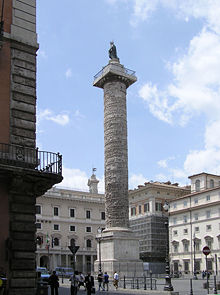
Continuing down the Via Something or Other, which by the way has an interesting array of shops and restaurants whose proprietors were busily restocking for the day's business, is quite interesting. Except for the fact that we were never quite sure just exactly where we were, who is to care.  Getting  a bit lost this time, landed us in the Piazza Colonna to the discovery of  The Column of Marcus Aurelius. Oh my!

 The column’s shaft is 29.60 m (about 100 feet) high, on a 10 m high base, which in turn originally stood on a
3 m high platform - the column in total is 41.95 m. About 3 metres of the base have been below ground level since the 1589 restoration. The column consists of 27 or 28 blocks of  Carrara marble (the good stuff that Michelangelo used), each of 3.7 m diameter, hollowed out at the quarry for a stairway of 190-200 steps within the column up to a platform at the top. This stairway is illuminated through narrow slits into the relief.


Just look at the detail. It is so beautiful.


Finally, we arrive at the Piazza Della Rotonda. Many of these squares contain obelisks. This one is called the Obelisk of Ramesses.


This square is most famous for the Pantheon, which was originally built in 27 BC by Marcus Agrippa and reconstructed by Hadrian in the early 2nd century. The Pantheon is a perfect sphere, at 142 ft wide and 142 feet high, as is it's dome. Before the 20th century, this was the biggest pile of concrete ever constructed.

The oculus (latin for "eye") is an opening in the dome which is 30 feet in diameter and allows rain to enter. See the bird in the opening.


The Pantheon was originally a pagan temple but in 609, the Byzantine emperor Phocas gave the building to Pope Boniface IV, who converted it into a Christian church and consecrated it to Sancta Maria an Martyres, now known as Santa Maria dei Martiri.
 
Here it is decorated for Palm Sunday services.


Raphael and Vittorio Emanuele II, king of Italy, and his successor, Umberto I, are buried in the Pantheon. It is a beautiful space, which we visited twice. The first time was in the morning and it was ever so peaceful. The second time was on the eve of Palm Sunday and while it was beautiful because a choir was singing, it was ever so crowded and the sense of space was lost.

Friday, April 23, 2010

The Trevi Fountain

Rick and I headed out from our hotel on foot. Our destination was the Vatican by way of a few intended sights. With map in hand, we looked for the streets indicated but most of them turned out to be more like alleyways. Street signs are engraved blocks on the sides of buildings. Our first destination was the Trevi Fountain.

This fountain is enormous!


It was based on the design of Nicolo Salvi and built from 1732-1762.

The central figure of the fountain, in front of a large niche, is Neptune, god of the sea. He is riding a chariot in the shape of a shell, pulled by two sea horses.


Each sea horse is guided by a Triton. One of the horses is calm and obedient, the other one restive. They symbolize the fluctuating moods of the sea.


In the niches flanking Neptune, Abundance spills water from her urn


and Salubrity holds a cup from which a snake drinks.


Before I went to Italy, I rented the movie Three Coins in the Fountain. I had never seen this film but do think it has contributed significantly to the popularity of this fountain. The movie suggests that if you throw a coin over your shoulder, you will find true love. In Rome, the legend has it that if you toss the coin, then you will return to Rome. I couldn't chance not returning to Rome and so in the coin went.

Friday, April 16, 2010

Borghese Gallery

A wander (def: to go by an indirect route, in our case also unknown) north from our hotel took us to the Borghese Gallery. I was told to make reservations ahead of time, which I did, on line. It was a good thing as none were to be had for the days we would be in Rome. Pictures were not allowed either and so I borrowed these from copyright free places on the internet.

This villa was originally built in the early 1600's and was restored to it's original condition in 1997.


It houses a substantial portion of the Borghese family collection of paintings and sculptures begun by Cardinal Scipione Borghese, the nephew of Pope Paul V (reign 1605–1621).

Scipione Borghese was an early patron of  Gian Bernini, and thus many of his works are housed here.

My favorite of everything I saw was a fresco on the second floor in the Gallery of Lanfranco, named The Council of the Gods. This fresco decorates the ceiling of a large room, called Sala della Loggia and was done in 1624 by Giovanni Lanfranco.  At the centre is set the scene of the gods gathered in council around Jupiter. This room had originally been an outdoor room and so the fresco had deteriorated. Between 1779 and 1782 the  ceiling  was restored by Domenico Corvi (1721-1803), who added the paintings on the walls and arches. The ceiling is a fresco, which is a painting done in wet plaster. Small sections are worked at a time so the painting can be completed before the plaster dries. The apparent statuary of  men holding up the ceiling all around the edges is done in the trompe-l'oeil style, which tricks the eye into thinking it is 3-D. It was utterly amazing!

I sat in a chair on the edge of the room and looked at this painting for a long time. It was so beautiful.


I had not yet seen the Sistine Chapel.