Monday, May 10, 2010

Ponte Saint' Angelo

These photos give new meaning to the the words "light at the end of the tunnel". After wandering delightful alleyways and never really being sure we were on the right track, we could see light...at the end of the tunnel.
Blessings!


We spot our destination, the Ponte Sant' Angelo, the Bridge of Angels.


Image by Matthias with his permission.
http://en.wikipedia.org/wiki/File:StAngelo_Bridge_Rome.jpg

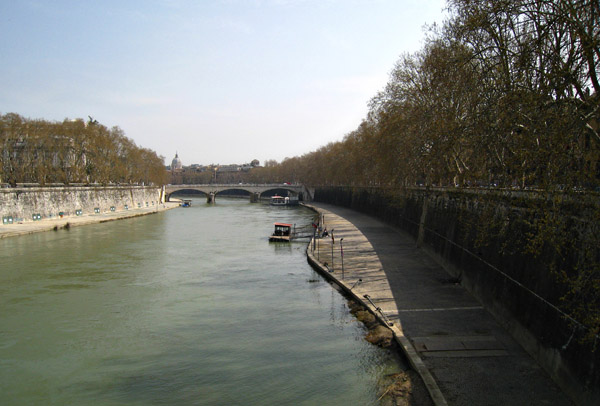
This Bridge spans the Tiber River, connecting the city center to the Castel Sant' Angelo.


The statuary on this bridge has been replaced several times in it's history. Bernini's program, one of his last large projects, called for ten angels holding instruments of the Passion.  He personally only finished the two originals of the Angels with the Superscription "I.N.R.I." and with the Crown of Thorns, but these were kept by Clement IX for his own pleasure. They are now in the church of Sant'Andrea delle Fratte, also in Rome.
The remaining angesl were sculpted by students of Bernini.


Angel with the Whips 


Angel with Cross
If you want to see an awesome artistic rendering of this photo, see Photoworks


Also on the bridge are sculptures of Sts Peter and  Paul. These remain from one of the earlier artistic renderings. Pigeons are the ruin of all photographers in Rome. I am pretty sure the locals don't care much for them either. And I am positive that St Peter doesn't.

If you look closely, you can just see the Sculpture of St Michael the Archangel on top of the Castel behind.

Tuesday, May 04, 2010

Piazza Navona

This piazza is large and open and has three delightful fountains.

In the center is Bernini's Fountain of the Four Rivers, representing the Nile, Ganges, Danube and della Plata. It was erected in 1651 in front of the church of Sant'Agnese in Agone, and yards from the Pamphili Palace belonging to this fountain's patron, Pope Innocent X  (1644-1655). This sculpture was being refurbished and was surrounded by plastic. Boo Hoo.
You can see the church with it's twin towers just behind the scuplture.


The Moor Fountain, located in the southern area of Piazza Navona, takes its name from the central figure, who is a Moor fighting with a dolphin. The work was sculpted based on a design of Bernini in 1654 by Giovanni Antonio Mari.


This fountain had all the water so the pigeons liked it as much as I did.
Gotta love those buns!


And then one who will sing?dance?sit? just whatever for his supper. This is not the third fountain although he seems to have been here long enough for green things to begin growing...


Hmmm!

Monday, May 03, 2010

Next Stop - the Pantheon by way of Piazza Colonna

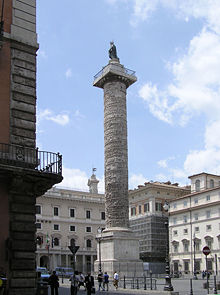
Continuing down the Via Something or Other, which by the way has an interesting array of shops and restaurants whose proprietors were busily restocking for the day's business, is quite interesting. Except for the fact that we were never quite sure just exactly where we were, who is to care.  Getting  a bit lost this time, landed us in the Piazza Colonna to the discovery of  The Column of Marcus Aurelius. Oh my!

 The column’s shaft is 29.60 m (about 100 feet) high, on a 10 m high base, which in turn originally stood on a
3 m high platform - the column in total is 41.95 m. About 3 metres of the base have been below ground level since the 1589 restoration. The column consists of 27 or 28 blocks of  Carrara marble (the good stuff that Michelangelo used), each of 3.7 m diameter, hollowed out at the quarry for a stairway of 190-200 steps within the column up to a platform at the top. This stairway is illuminated through narrow slits into the relief.


Just look at the detail. It is so beautiful.


Finally, we arrive at the Piazza Della Rotonda. Many of these squares contain obelisks. This one is called the Obelisk of Ramesses.


This square is most famous for the Pantheon, which was originally built in 27 BC by Marcus Agrippa and reconstructed by Hadrian in the early 2nd century. The Pantheon is a perfect sphere, at 142 ft wide and 142 feet high, as is it's dome. Before the 20th century, this was the biggest pile of concrete ever constructed.

The oculus (latin for "eye") is an opening in the dome which is 30 feet in diameter and allows rain to enter. See the bird in the opening.


The Pantheon was originally a pagan temple but in 609, the Byzantine emperor Phocas gave the building to Pope Boniface IV, who converted it into a Christian church and consecrated it to Sancta Maria an Martyres, now known as Santa Maria dei Martiri.
 
Here it is decorated for Palm Sunday services.


Raphael and Vittorio Emanuele II, king of Italy, and his successor, Umberto I, are buried in the Pantheon. It is a beautiful space, which we visited twice. The first time was in the morning and it was ever so peaceful. The second time was on the eve of Palm Sunday and while it was beautiful because a choir was singing, it was ever so crowded and the sense of space was lost.

Friday, April 23, 2010

The Trevi Fountain

Rick and I headed out from our hotel on foot. Our destination was the Vatican by way of a few intended sights. With map in hand, we looked for the streets indicated but most of them turned out to be more like alleyways. Street signs are engraved blocks on the sides of buildings. Our first destination was the Trevi Fountain.

This fountain is enormous!


It was based on the design of Nicolo Salvi and built from 1732-1762.

The central figure of the fountain, in front of a large niche, is Neptune, god of the sea. He is riding a chariot in the shape of a shell, pulled by two sea horses.


Each sea horse is guided by a Triton. One of the horses is calm and obedient, the other one restive. They symbolize the fluctuating moods of the sea.


In the niches flanking Neptune, Abundance spills water from her urn


and Salubrity holds a cup from which a snake drinks.


Before I went to Italy, I rented the movie Three Coins in the Fountain. I had never seen this film but do think it has contributed significantly to the popularity of this fountain. The movie suggests that if you throw a coin over your shoulder, you will find true love. In Rome, the legend has it that if you toss the coin, then you will return to Rome. I couldn't chance not returning to Rome and so in the coin went.

Friday, April 16, 2010

Borghese Gallery

A wander (def: to go by an indirect route, in our case also unknown) north from our hotel took us to the Borghese Gallery. I was told to make reservations ahead of time, which I did, on line. It was a good thing as none were to be had for the days we would be in Rome. Pictures were not allowed either and so I borrowed these from copyright free places on the internet.

This villa was originally built in the early 1600's and was restored to it's original condition in 1997.


It houses a substantial portion of the Borghese family collection of paintings and sculptures begun by Cardinal Scipione Borghese, the nephew of Pope Paul V (reign 1605–1621).

Scipione Borghese was an early patron of  Gian Bernini, and thus many of his works are housed here.

My favorite of everything I saw was a fresco on the second floor in the Gallery of Lanfranco, named The Council of the Gods. This fresco decorates the ceiling of a large room, called Sala della Loggia and was done in 1624 by Giovanni Lanfranco.  At the centre is set the scene of the gods gathered in council around Jupiter. This room had originally been an outdoor room and so the fresco had deteriorated. Between 1779 and 1782 the  ceiling  was restored by Domenico Corvi (1721-1803), who added the paintings on the walls and arches. The ceiling is a fresco, which is a painting done in wet plaster. Small sections are worked at a time so the painting can be completed before the plaster dries. The apparent statuary of  men holding up the ceiling all around the edges is done in the trompe-l'oeil style, which tricks the eye into thinking it is 3-D. It was utterly amazing!

I sat in a chair on the edge of the room and looked at this painting for a long time. It was so beautiful.


I had not yet seen the Sistine Chapel.

Thursday, April 15, 2010

Santa Maria Maggiore

A quick walk from our hotel, led us to the Basilica of Santa Maria Maggiore. A basilica is an important church that has been given special ceremonial rites by the Pope. There are four basilicas in Rome and this is the oldest. It dates back to the 4th century. Something that old is hard to imagine.


The condition of the exterior is a bit underwhelming, but then hey, it is quite old. We should look so good.

I especially like the dandelions growing on the statuary.


But walk inside and you will be totally amazed.


The center aisle.


The sculptures.


The mosaics.


The paintings and frescoes
in even a side chapel.


The gold leafing.


Every little detail ...
a piece of art


Even the floors are stunning marble mosaics.


If you have ever been to Rome, then you know that the work of sculptor, Gian Lorenzo Bernini is everywhere. He is buried in this church and his epitaph simply states "He decorated the city."

Sunday, April 11, 2010

First Impressions

We arrived in Rome on Thursday, March 25 at about 7 AM, just a tad bit tired and waited for what seemed like forever for our luggage. Good thing it was marked PRIORITY. Otherwise we might still be waiting. Our prearranged transport was spot on, holding that oh so welcomed sign "Millar". Thank God we did not have to drive. Traffic in Rome is comparable to traffic in China--hectic.

Lots and lots of small cars everywhere.


And motorcycles jutting in an out. I have never seen so many and they create new lanes of traffic on an impromptu basis.


Parking meters don't exist and so a bit of the cost incentive to find alternative transport is missing. The trick is finding a place to park your vehicle and probably the reason why vehicles are small. Some are parked on curbs; some are double parked; some even triple. Narrow streets become even narrower and so commences the horn honking. Music to your ears?

Another note is the graffiti on many buildings.


Some more artistic than others but everywhere.


But my favorite, which I have saved for last is the landscape of trees, called umbrella pines, that grow in this area. Simply gorgeous...

Saturday, April 10, 2010

Ciao, Italia

The trip begins with a very long flying day. Leaving Portland at 7: 15 AM and landing in DC, our first destination. A 2+ hour layover and then on to Italy at 5:30 PM. Eight hrs in the air until arrival in Rome. How to pass that much time. Besides sleep, I found a very good book to read, which has been sitting on my shelf for just the right opportunity.


Michelangelo and the Pope's Ceiling by Ross King tells the story of how Michelangelo who considered himself to be a sculptor and who had already completed two very famous pieces, the Pieta and David, was forced to work as a painter using a fresco technique for which he had very little experience. The story describes not only Michelangelo's challenges and triumphs but also shares the history and politics of the day.

A fascinating read and most appropriate for a field trip to Italy. 

Did you know that in Italy, the name Michelangelo is pronounced as if it rhymes with nickel + angelo.

Monday, March 22, 2010

Get Out of Town

Travel to the next county, the next state, the next continent. Experience something different for a change. View a different landscape, a bigger skyscape. Meet people who talk differently from you, who look different, who are different.

Ahhhh! Italy!
Buongiorno!
Come sta?

Wednesday, March 10, 2010

Oh When Those Saints go Marching In

Week 6 - SuperBowl Party
Just a tad late, don't cha think...
But don't much care either.


Till next time!

Friday, March 05, 2010

Voices Contemporary Lectures

If you live in Portland, run, don't walk and sign up for next
season's Voices lecture series. It is money well spent.


My week 5 highlight was having the opportunity to hear
Dee Dee Myers speak. At age 31, she was President
Clinton's Press Secretary and served in this position for
2 years. She most recently wrote a book by the title
Why Women Should Rule the World. It is not a male
basher but rather discusses the gifts women bring to
the table in business or politics or life.  Myers also
encourages women to give consideration to the voice
they use when speaking of their own achievements

As a side, she graduated from Santa Clara University,
which is where my girlie goes to school.

Totally loved Week 5.

Wednesday, March 03, 2010

Wabi Sabi Eye Candy

I needed some industrial cloth for a project I am working on.
As I mentioned, I had a pile of fabrics that really were bad dye jobs. I also had a bottle of Jacquard's Discharge Paste. This cloth is the result.

These are made using a three layer
process. For the bottom layer, I
placed some type of texture: drawer
material, bubble wrap, just whatever. 
Then the "bad dye job" cloth. The
top layer is a household screen. it
provides some additional
texture and adds the feature of holding
the cloth in place.Using a sponge roller,
I applied the paste. The biggest trick is
learning how heavy a hand to use. 
Too much and all the color is removed.
Too little and you don't alter the cloth
much. It's all in the wrist.
Some cloth was not as successful. To
these, I will add some additional texture
with thickened dye and then remove
some more. The final layer will be 
and Layers. PS has really helped me
They are even better up close and
personal. The colors are much richer.
They are delicious!